State dental insurance reforms continue momentum in 2026 legislative sessions

As most state legislatures conclude their 2026 sessions, lawmakers across the country have continued advancing dental insurance reforms aimed at improving transparency, strengthening patient protections and reducing administrative burdens on dentists.
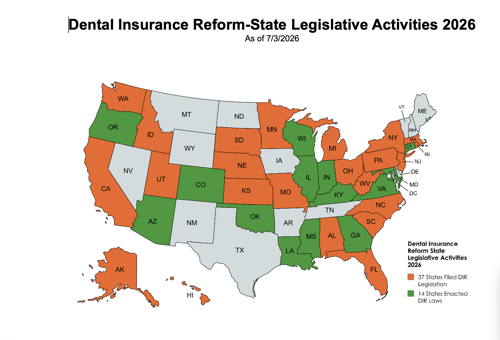
More than 100 dental insurance reform bills were introduced in 37 states during the 2026 legislative season. So far, 16 states have enacted 30 new laws, with additional measures still awaiting governors' signatures.
The legislative successes build on years of advocacy by state dental associations working alongside the ADA to address longstanding concerns involving dental benefit plans. This year's activity focused on issues including dental loss ratios, virtual credit card payments, network leasing, assignment of benefits, retroactive claim denials and downcoding.
According to the ADA, this steady trend of enacting new dental insurance reform laws is rooted in effective advocacy strategies from membership funneled through their state constituent societies along with support from the Association.
Dental loss ratio
Ten states considered dental loss ratio legislation during the 2026 session.
Mississippi enacted a new law requiring dental insurers to report the percentage of premium dollars spent on patient care, creating greater transparency for employers, consumers and policymakers evaluating dental plans.
According to the ADA, the Mississippi Dental Association worked closely with legislators to address technical questions regarding dental loss ratio calculations after insurers raised concerns about how spending should be measured. Following a review of existing state laws, supporters demonstrated that the bill's methodology aligned with approaches already adopted elsewhere, helping advance the legislation.
Virtual credit cards
States also continued efforts to address insurer payment practices.
Wisconsin enacted legislation limiting insurers' exclusive use of virtual credit cards, ensuring dentists have a choice in how they receive claim payments. The new law enacted in Michigan was one of only a few bills to be approved in the 2026 session. Even with legislative impasse being the prevailing environment, it was the continued promotion of the virtual credit card law’s value that helped get the law passed as one of only 65 enacted out of the 3300 bills filed this year.
Georgia and Louisiana strengthened existing virtual credit card laws by replacing an opt-out system with an opt-in requirement. Under the new approach, insurers must obtain a dentist's express permission before issuing payment through a virtual credit card or another payment method that carries transaction fees.
Georgia Dental Association Senior Health Policy Manager Jon Hoin said House Bill 1374 was modeled after updates to the National Council of Insurance Legislators’, or NCOIL, Transparency in Dental Benefits Contracting Model Act adopted with support from the ADA.
“Georgia’s recent [House Bill] 1374 was modeled after a recent update to the Transparency in Dental Benefits Contracting Model Act supported by ADA at NCOIL last fall. The bill updates existing language to require ‘express consent’ (or an opt-in) to virtual credit card and any form of payment that would incur additional fees to the dentist. Previously, Georgia law required companies to allow the dentist to opt-out. The law also requires that the dentist's payment method decision to remain in place until a future contract is executed,” Mr. Hoin said.
Mr. Hoin credited Rep. Lee Hawkins, D.M.D., the bill’s sponsor, and Sen. Ben Watson, M.D., for helping guide the legislation through the General Assembly.
“The bill enhances existing regulation of the use of virtual credit cards to maximize dentists’ — and in Georgia all healthcare providers — choice of payment method from insurance companies,” he said. “Virtual credit cards, and other payment methods that require a fee, can be quite expensive for practices cutting into the bottom line and reducing funds available for staffing, investment in quality improvement, and other things that directly benefit dentists and their patients.”
Network leasing
Seven states introduced legislation addressing network leasing this year, with Colorado and Wisconsin both enacting new protections.
Colorado became the second state to require insurers to obtain a dentist's permission before including that dentist in a leased network. The law also prohibits insurers from penalizing dentists who decline to participate and increases transparency by requiring payment explanations to identify the source of any network discounts.
Colorado Dental Association President Jeff Lodl, D.D.S., said the legislation gives dentists greater control over their contractual relationships while improving transparency for patients.
“The CDA is proud to have passed a network leasing bill that puts dentists in control of their contracts with insurance carriers and gives them the power to decide whether or not they will be part of a leased network,” he said. “Colorado’s House Bill 1070 adds much needed clarity and transparency to insurance contracting for dental services."
He said House Bill 1070 ensures there is an opt-in process that carriers must follow for network leasing, rather than making dentists scramble after they’ve already been added to a leased network without their express consent.
“This is important for dentists to have a say in what dental benefit plans they will be part of, and really important for patients to know that they’re getting accurate and reliable cost estimates for dental services, based on their dental benefit plans,” Dr. Lodl said.
He also said the bill requires communication from carriers to dentists about leased networks to ensure dental offices have the information they need about insurance plans that they are part of.
“Uncertainty and financial strain can be avoided by simply ensuring dentists are agreeing to be part of dental benefit networks, and ensuring they are informed about the terms and conditions of those benefit networks, which is what House Bill 1070 achieves,” Dr. Lodl said.
Wisconsin also enacted legislation allowing dentists to terminate participation in a leased network without terminating their original provider contract while preserving existing transparency requirements governing leased networks.
Assignment of benefits
Oregon and Maryland enacted assignment of benefits legislation this year, bringing the total number of states with assignment of benefits laws to 30.
The new laws require insurers to pay dentists directly when patients request assignment of benefits regardless of whether the dentist participates in the insurer's network. Maryland's law also establishes patient notification requirements regarding payments made directly to patients when assignment of benefits is not selected.
Retroactive denials
Several states also narrowed insurers' ability to seek repayment of previously paid claims.
Connecticut reduced the period during which insurers may seek recovery of overpayments from 18 months to 12 months.
Indiana shortens its recoupment period from two years to 180 days under their new law, while Oregon establishes an 18-month limit on repayment requests and also requires dental insurers to pay or deny clean claims within 45 days.
Downcoding
Indiana enacted legislation establishing new standards governing insurer downcoding practices.
The law prohibits insurers from relying solely on automated systems when reducing reimbursement based on medical necessity, instead requiring review by an individual. It also requires insurers to provide written explanations supporting downcoding decisions, establishes an appeals process and allows providers to submit batch appeals involving substantially similar claims.
Shane Springer, director of government affairs for the Indiana Dental Association, said the legislation provides long-sought transparency for dentists.
“What this bill does is really establish guardrails around downcoding. It ensures that, if something is downcoded, it’s clinically justified, transparent, and cannot be done through an automated process. It has to have a human review of the dental records,” he said.
Mr. Springer said the legislation came together unexpectedly after association leaders noticed the bill initially applied only to medical providers.
“It really wasn’t on our radar this session if I’m going to be honest. We were actually looking at going after this downcoding language in 2027 but we noticed when the bill was filed back in January, it applied only to medicine. That’s when I reached out to the bill author and the bill sponsor and said, ‘Hey guys look this is a huge problem in dentistry as well. Can we please be included on this bill?’,” Mr. Springer said. “So it was kind of the cherry on top to a turbulent, short session. It was something where we saw an opportunity and we took it.”
He added that the law addresses a longstanding concern among dentists.
“At the end of the day, we just really want to ensure dentists can focus on patient care, while reducing the burden and the financial uncertainty that they’re experiencing with this recoupment and downcoding. So it’s a pretty good win for dentistry,” he said.
Comprehensive reforms-provider protections
Utah enacted a robust dental insurance reform law encapsulating several measures ensuring dentists retain more control over practice management decisions. For example, dental insurers are prohibited from charging a fee for paper checks. Explanation of benefits reforms include a prohibition on insurers suggesting that non-coverage results in a write-off for dentists and a requirement that explanation of benefits include reasons for any downcoding or bundling.
Another new provision prohibits insurers from forcing dentists to submit their regular fees on claims which helps prevent insurers from showing the patient the "discount." Insurers cannot penalize dentists based on whether they file their own fee or the insurers’ contracted fee when filing claims.
Prior to this law, insurers could apply out-of-state payment laws under certain circumstances. Now regardless of the location of the insurer's principle place of business, location where the dental plan was written, issued, or delivered, or a contractual choice-of-law provision, insurers must comply with all Utah payment laws for services provided so long as at least 10% of enrollees are Utahans. Dentists are protected from undisclosed policy changes and shifting administrative requirements under the handbook provisions in the law.
Terms ‘professionally accepted treatment’ and ‘unbundling’ now are defined in statute to ensure when used as part of a claim adjudication, they are accurate and align with ethical patient care while protecting dentists from insurers’ retaliation.
Federal focus
Although states continue to enact dental insurance reforms, according to the ADA many of those protections do not apply to patients covered by self-funded employer plans because of how certain insurers interpret the Employee Retirement Income Security Act, or ERISA.
According to the ADA, insurers administering many large self-funded employer plans have asserted that ERISA preempts numerous state insurance laws, limiting the reach of state dental insurance reforms for many covered patients.
To address that issue, the Association is advocating for the Improving Dental Administration, or IDA, Act, federal legislation that the ADA says would clarify that state dental insurance laws apply more broadly and prevent insurers from avoiding those requirements through ERISA preemption.
“We need to fix this ERISA loophole that keeps state regulators from enforcing pro-consumer insurance laws enacted in their states,” said Richard Rosato, D.M.D., president of the American Dental Association. “Patients and providers should not be left unprotected based simply on how their dental benefits are purchased.”
The ADA said it encourages dentists to engage with members of Congress in support of the legislation, highlighting that federal action is needed to ensure patients enrolled in self-funded dental benefit plans receive the same protections available under many state laws.
Dentists wanting to learn more about ERISA and dental insurance reform can visit www.ada.org/ERISA, and those wanting to take contact their member of Congress about support for IDA can do so here: https://www.ada.org/advocacy/grassroots-action-center/ida-alert