June JADA highlights dentists’ role in rare disease management
Many disorders have diverse oral manifestations
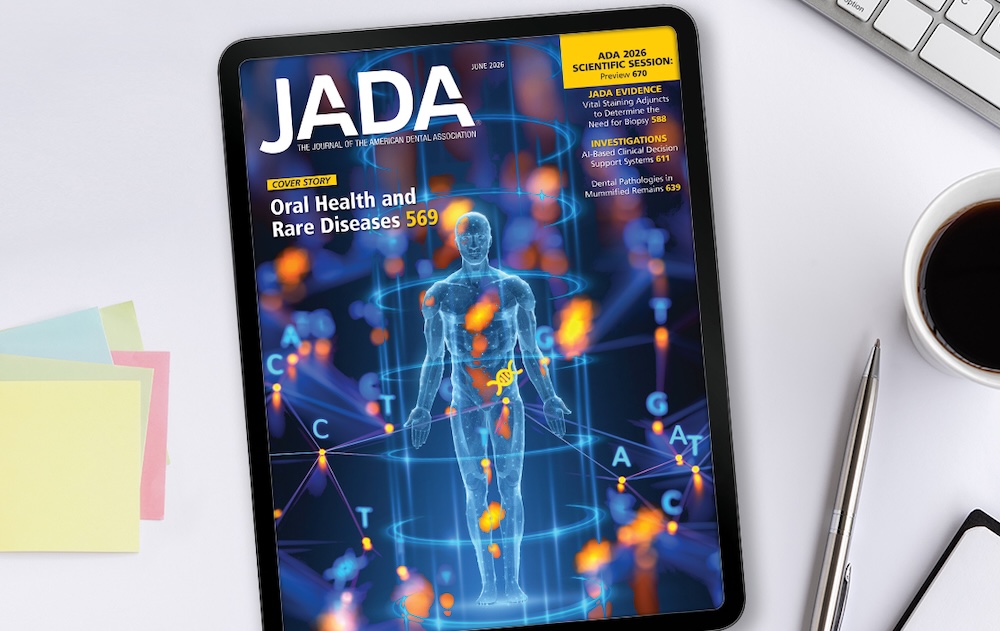
While research, treatments and standard terminology are lacking for rare diseases, dentists can play a role in screening for oral signs and making prompt referrals, according to the cover story of the June issue of The Journal of the American Dental Association.
“Rare Diseases: Challenges for Optimal Oral Health” is the latest addition to JADA’s Oral Science Trends series, which consists of invited reviews that explain where current biomedical and clinical sciences are leading to impactful changes in dentists’ ability to provide care and improve health. The review includes literature on rare diseases and oral healthcare from 1990 through March 30, 2026.
The cover story was written by Tim Wright, D.D.S., editor-in-chief of JADA and professor in pediatric dentistry and dental public health at the University of North Carolina at Chapel Hill Adams School of Dentistry, and Davis Thomas, D.D.S., clinical associate professor at the Center for Temporomandibular Disorders and Orofacial Pain at Rutgers School of Dental Medicine. It is the first article to be published on the JADA website from a special issue dedicated to rare diseases, with more to follow. The issue’s aim is to help equip clinicians with the latest diagnostic and therapeutic developments to support the provision of evidence-based care for patients with rare diseases.
A rare disease is a chronically debilitating condition that affects a small proportion of the population, but what is considered a “small proportion” varies by location and organization, according to the article. In the U.S., a rare disease is one that affects fewer than 200,000 people. Some of the more common rare diseases include sickle cell disease, Ehlers-Danlos syndrome and cystic fibrosis.
Overall, rare diseases impact an estimated 30 million people in the U.S. Few have available cures, and their wide array of causes and characteristics make them difficult to diagnose and treat, according to the article. Rare diseases often have diverse craniofacial, oral and dental manifestations affecting the soft tissues, salivary function, dentition, and skeletal and facial structures.
“Dental care providers can pick up subtle signs and symptoms along with the more overt ones, representing groups of conditions,” Drs. Wright and Thomas said in the article. “Many of the pathognomonic symptoms and signs are oral manifestations. Dentists, therefore, are the guardians for these patients to aid in early recognition, identifying phenotypes that are outside the norm, making appropriate prompt referrals, and facilitating a patient’s entry into the medical and oral healthcare systems.”
Other articles in the June issue of JADA discuss vital staining adjuncts to determine the need for biopsy, artificial intelligence-based clinical decision support systems and dental pathologies in mummified remains.
Every month, JADA articles are published online at JADA.ADA.org. ADA members can access JADA content with their ADA username and password.