ADA council addresses orthopedic guideline on dental care for prosthetic joint patients
Position statement first to be published as part of new JADA feature
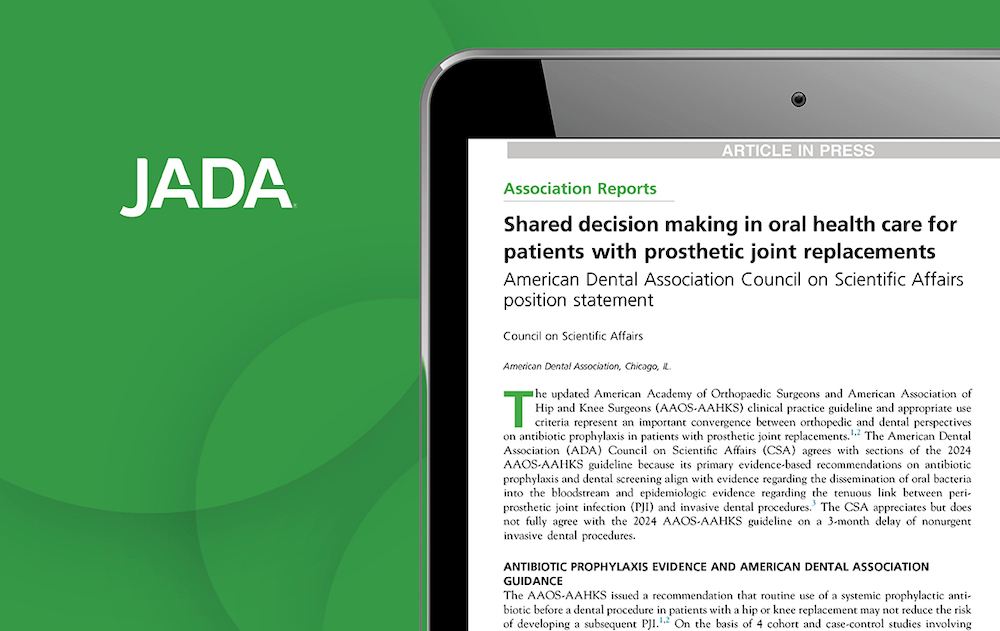
In a position statement published in The Journal of the American Dental Association, the ADA Council on Scientific Affairs shared it agrees with part but not all of an American Academy of Orthopaedic Surgeons and American Association of Hip and Knee Surgeons clinical practice guideline on oral health care for patients with prosthetic joint replacements.
The 2024 orthopedic guideline’s primary recommendations on antibiotic prophylaxis align with the ADA’s own clinical practice guideline from 2015.
“The position statement reenforces the ADA’s long-held position that antibiotic prophylaxis is generally contraindicated in immunocompetent patients and that in the case of immunocompromised patients, the orthopedic surgeon should prescribe the appropriate drug and dose on the basis of the patient’s medical conditions,” said Kevin Schwartz, D.M.D., a member of the Council on Scientific Affairs.
However, the council stated it appreciates but does not fully agree with the orthopedic guideline’s recommendation to delay “nonurgent” invasive dental procedures for three months.
“The CSA is pleased to see the guideline largely aligns with the ADA's established recommendations. However, it is vital to clarify that the suggested three-month delay for nonurgent dental work is a clinical opinion, not an evidence-informed recommendation,” said Jennifer Holtzman, D.D.S., chair of the council. “Decisions regarding oral health care following a joint replacement should not be a matter of routine delay but rather a shared decision between the dentist, the orthopedic team and the patient. This approach balances joint stability with optimal patient health and well-being.”
The position statement, posted online April 16 ahead of the June issue, is the first to be published as part of Association Reports, a new feature in JADA. Moving forward, the council is expected to write and publish about three to four position statements each year on various topics.
“The new ADA CSA position statement will be a powerful resource for dentistry in the management of the ever-growing population of patients receiving prosthetic joint replacements,” Dr. Schwartz said. “It serves as a valuable tool written to bring clarity to both the dental provider and orthopedic surgeon in their decision-making related to the indications for and timing of treatment in the perioperative period. The benefits to both providers and patients will be substantial.”