New ADA president highlights power of organized dentistry
Thomas Paumier, D.D.S., addresses House after being installed as 163rd president
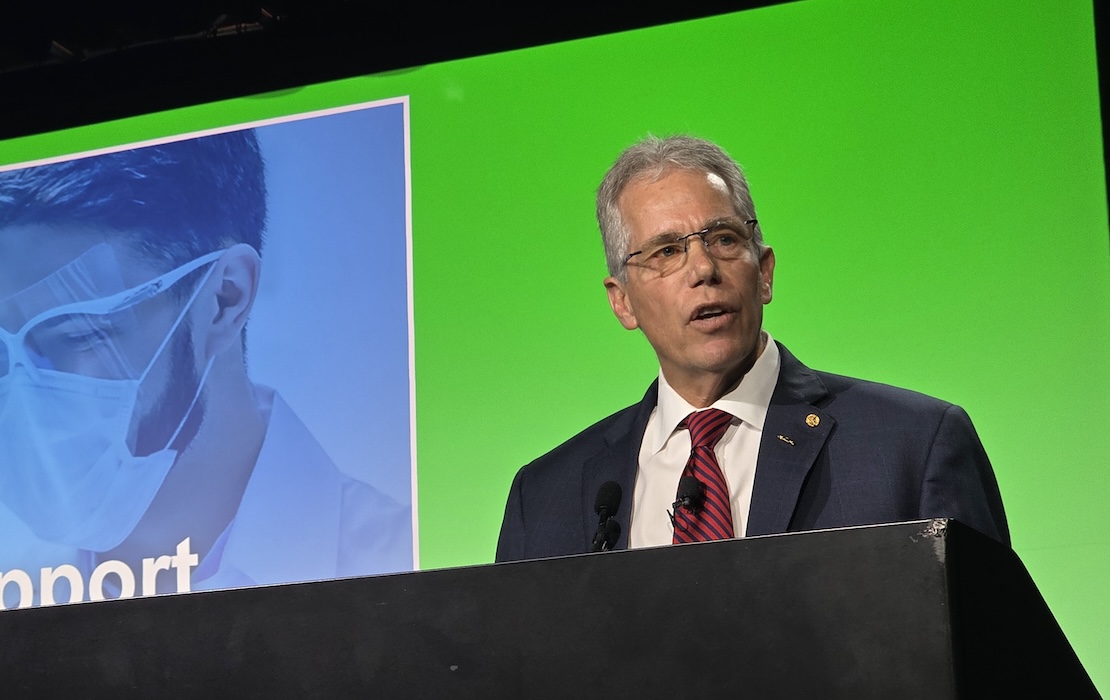
Today, somewhere in the U.S., a dentist is using a high-speed handpiece to restore a tooth. The bur in that handpiece is rotating at 300,000-400,000 revolutions per minute, and yet, the dentist is not concerned about the bur flying out of the handpiece and injuring the patient.
Why? Because standards developed by the American Dental Association ensure that the handpiece and the bur fit together, regardless of the manufacturer that produced each one.
This was just one of the examples of the ADA’s value that incoming ADA President Thomas Paumier, D.D.S., shared with the House of Delegates during his address Oct. 12 in Indianapolis after being installed as the Association’s 163rd president.
“We rarely think about these things. We simply trust that they will work, and so do our patients,” Dr. Paumier said.
During his address, Dr. Paumier highlighted the unique value the ADA brings at a national level to its members and the dental profession, not only in relation to standards, but also in science, advocacy and practice support.
He also shared the strides the ADA has made over the last year to increase transparency and listening and discussed how he plans to continue those efforts through the governance and organizational health evaluation, which is examining the ADA’s governance structure, financial health and sustainability, and leadership culture and accountability.
“We have turned a corner. Now we must decide where we are going,” said Dr. Paumier, a general dentist from Canton, Ohio. “I ran for this office, not to fulfill a personal agenda, but because I believe deeply in this profession and the ability of organized dentistry to make it stronger. The governance and organizational health evaluation is an important part of determining our path forward.”
He explained how some changes will take time to implement, as transformation needs to be built on a foundation of collaboration. He also indicated transformation does not always mean creating something entirely new.
“Sometimes transformation means rediscovering what made you indispensable in the first place and finding new ways to deliver it,” Dr. Paumier said.
In that spirit, he plans to focus his term on the core pillars of science, advocacy, standards and practice support.
Dr. Paumier shared how the ADA remains committed to science through research, the development of evidence-based clinical practice guidelines and the work of the ADA Forsyth Institute. He also highlighted the achievements of tripartite-led advocacy.
“We are America’s leading advocate for oral health and the dental profession, and we are strongest when all three levels of our tripartite work together,” Dr. Paumier said. “Working with our state partners this year, more than 30 insurance reform laws have been passed in 16 states, and when 15 state legislatures considered restrictions on community water fluoridation, not one of those bills became law.”
For the last century, ADA standards have helped ensure the safety, quality and reliability of dental care, and the next century may prove even more important as artificial intelligence use becomes more prevalent in dentistry, said Dr. Paumier, highlighting how AI must be used ethically.
He also addressed the challenges faced by ADA member dentists involving dental benefits, workforce shortages, regulatory compliance, wellness and practice management. He pointed to resources available from the ADA and state and local dental societies while also acknowledging those tools must be easy to find and use, as well as relevant to dentists at every career stage and in every practice model.
“Our members shouldn’t have to search for the value of belonging; they should experience it,” Dr. Paumier said.
A volunteer leader and member of the ADA for more than 35 years, Dr. Paumier has firsthand knowledge of the value of belonging to organized dentistry. He served as the vice chair of the ADA Strategic Forecasting Committee, the chair of the ADA Council on Members Insurance and Retirement Programs, and a member of the ADA Board of Trustees Finance Committee, the COVID-19 recovery task force and two scientific panels that developed clinical practice guidelines on antibiotic use.
At the state level, Dr. Paumier served as the president of the Ohio Dental Association and a member of the association’s Executive Committee. He also held other roles in the association, including treasurer, chair of the ODA Services Corp., chair of the Annual Session Committee and chair of the ODA Wellness Trust. Locally, Dr. Paumier is a past president of the Stark County Dental Society in Ohio.
“Membership is about value, but belonging is about something more,” he said. “Belonging means accepting responsibility for the future of the profession that gives us the privilege to practice. Individually and collectively, we must be responsible for safeguarding that future.”
Dr. Paumier asked delegates to imagine dentistry without a strong ADA, strong states and strong local components. Without the collective voice of the tripartite to help determine the future of dentistry, dentists would instead need to rely on policymakers, who may make decisions without understanding their impact on dentists and patients.
He then asked delegates to embrace a simple philosophy: we before me.
“Together, we can shape the future of our profession, and together, we will prove that the ADA’s best days are not behind us; they are in front of us,” Dr. Paumier said.