First ADA living guideline reaffirms dental exams crucial to detecting oral cancer early
Final recommendations published Sept. 28 in JADA
Clinical oral examinations are critical to the early detection of oral cancer while biopsies remain the gold standard for definitive diagnosis, according to the first guideline released from the ADA Living Guideline Program.
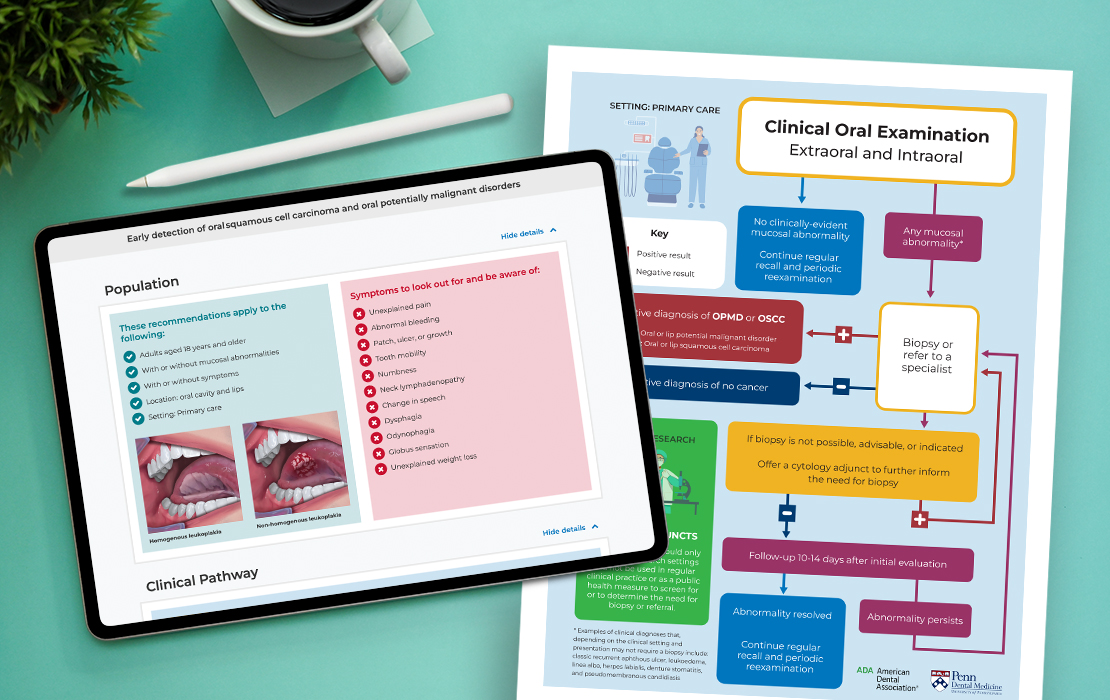
The living guideline on the early detection of oral squamous cell carcinoma and potentially malignant disorders reaffirms that clinicians should perform a comprehensive extraoral and intraoral clinical exam on all adults, communicate its role in the early detection of oral and lip lesions, and obtain patients’ updated medical, social and dental histories.
“Dental visits can save lives,” said Mark Lingen, D.D.S., Ph.D., guideline panel chair, professor of pathology at the University of Chicago Medicine and former member of the ADA Council on Scientific Affairs. “Oral cancers can be serious, but early detection often leads to better patient outcomes.”
The guideline also maintains that a punch or scalpel biopsy followed by histopathological assessment is the preferred and definitive method for diagnosing oral and lip squamous cell carcinoma and oral and lip potentially malignant disorders. When a biopsy is indicated, clinicians should pursue it promptly or refer the patient to a specialist for definitive diagnosis, according to the guideline.
“The most important message for clinicians is that the clinical intra- and extraoral examinations remain the foundation of early detection of oral potentially malignant disorders and oral cancer. Every adult patient should have an updated medical, social and dental history and a thorough clinical exam, whether it's a new patient visit, a routine recall or an emergency appointment,” said Alessandro Villa, D.D.S., Ph.D., ADA Council on Scientific Affairs guideline panel representative, chief of oral medicine, oral oncology and dentistry at Herbert Wertheim Cancer Institute, and professor of surgical sciences at the Herbert Wertheim College of Medicine. “For persistent or suspicious oral lesions, a biopsy remains the gold standard for a definitive diagnosis.”
Released this year in four parts, the living guideline addresses the use of cytology, vital staining, light-based and salivary adjuncts to determine the need for biopsy. Its final set of recommendations was published online Sept. 28 ahead of print in The Journal of the American Dental Association.
The guideline states these adjunctive tests should not replace an indicated biopsy or referral and generally recommends against their routine clinical use to determine the need for biopsy or referral in adults with clinically evident oral lesions or to screen asymptomatic adults without lesions. It states cytology may be offered in limited circumstances when a biopsy is not possible, advisable or indicated, and that salivary adjuncts should only be used in research settings.
If an oral lesion persists or progresses despite a negative cytology result, clinicians should immediately perform a biopsy or refer the patient to a specialist to avoid delayed diagnosis, according to the guideline. If a lesion does not resolve 10 to 14 days after an initial evaluation and there is no definitive diagnosis or treatment plan, clinicians should recommend a prompt biopsy or referral to a specialist.
"Early detection of oral cancer depends on the timely evaluation and biopsy of suspicious lesions,” said Shelley Olson, D.D.S., chair of the ADA Council on Dental Benefit Programs. "Evaluations referred to a specialist, diagnostic oral biopsy and related pathology services should be routinely covered by any health plan or dental benefit program. Coverage should not be based on the location of the lesion, the coding pathway used to submit the claim or the ultimate diagnosis."
When a patient returns 10 to 14 days after the identification of a persistent or suspicious oral lesion, the follow-up is a medically necessary continuation of the diagnostic process — not a routine recall, Dr. Olson said.
“Third-party payers should provide coverage for these problem-focused follow-up evaluations without frequency limitations because the need for the visit is driven by a previously identified clinical condition, not by a routine examination schedule,” she said. “Timely reassessment is essential to determining whether further diagnostics, referral or biopsy are warranted and may ultimately facilitate earlier detection of oral cancer.”
Dr. Olson advises dentists to code the visit according to the services performed and documented, regardless of the timing of a prior examination.
Guidelines developed as part of the ADA Living Guideline Program, established in 2025, provide dentists and patients with more frequent evidence-informed recommendations to advance oral and overall health. The Living Guideline Program upholds the methodological rigor of traditional guidelines, but living guidelines are updated as soon as new evidence emerges instead of every three to five years like traditional guidelines. Learning and engagement related to the guideline program are supported in part by an unrestricted grant from Colgate Oral Pharmaceuticals.
This living guideline is an update to the ADA’s 2017 clinical practice guideline on the evaluation of potentially malignant disorders, including oral cancer. Its recommendations will be updated as new evidence becomes available, and the ADA will share any updates with dentists and patients.
Guideline development was led by the ADA in collaboration with a team of methodologists from the Center for Integrative Global Oral Health at the University of Pennsylvania School of Dental Medicine and an expert multidisciplinary panel. The ADA Council on Scientific Affairs provided oversight through topic approval, panel representation, and review and approval of the final guideline.
To read the full guideline online and access related interactive resources, visit ADA.org/OralCancerGuideline. The guideline is also available at JADA.ADA.org. It has been published in a new section of JADA called JADA Evidence, which will present living guidelines as they are developed to help bring the latest oral healthcare recommendations to clinicians.