September JADA highlights product development strategies that lead to clinical adoption
Other articles discuss AI ethics, dental fluorosis, oral cancer
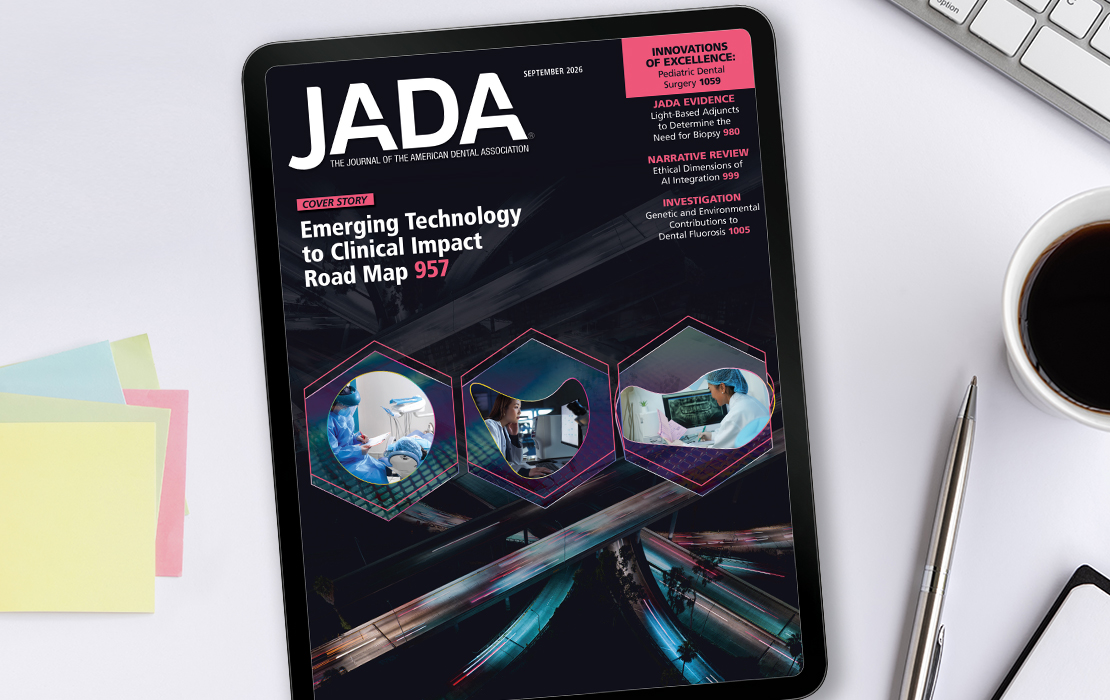
The September cover story of The Journal of the American Dental Association highlights the need to design scientific studies with the goal of translating findings into adoptable innovations.
“Driving Emerging Technology to Clinical Impact” is the latest addition to JADA’s Oral Science Trends series, which consists of invited reviews that explain where current biomedical and clinical sciences are leading to impactful changes in dentists’ ability to provide care and improve health.
“Dental, oral, and craniofacial regenerative medicine has benefitted from fundamental scientific discoveries, yet the resulting technologies and therapies do not always generate the anticipated clinical impact,” the authors wrote in the article. “Despite robust progress and substantial investment in biomaterials and tissue engineering, few breakthroughs have achieved widespread adoption in the clinical arena.”
The authors analyzed roadblocks to getting new technology into dentists’ hands, including complex regulatory procedures, gaps in meaningful clinical evidence that leads to clinician and patient buy-in, and economic and behavioral barriers that may discourage dentists from changing their workflows by incorporating new technology.
The authors challenged the traditional pathway for clinical product development — which frames U.S. Food and Drug Administration clearance as the end goal — stating clearance is not enough to encourage adoption. Adoption depends on aligning products with the needs of providers and patients and addressing considerations such as workflow integration, pricing and patient perception from the start, the authors wrote.
They proposed a different approach that frames clinical adoption as the ultimate goal from project inception, going beyond fulfilling minimum regulatory requirements regarding safety and basic efficacy to produce clinically meaningful evidence that is directly applicable to dental practice.
“Recognition of the clinical impact of innovative technologies in modern dentistry necessitates a reevaluation of how we design and interpret studies,” the authors wrote. “From the earliest studies in preclinical models to pivotal clinical trials and clinical assessments, the goal must be translational relevance, intuitive outcomes, and clinically relevant change. Such an approach will accelerate the clinical adoption of new technologies to enhance patient care.”
Other articles in the September issue of JADA discuss ethical considerations for integrating artificial intelligence into dental practice, genetic and environmental contributions to dental fluorosis in primary teeth, and risk assessment for oral potentially malignant disorders.
Every month, JADA articles are published online at JADA.ADA.org. ADA members can access JADA content with their ADA username and password.